
Est. 2019
Est. 2019
Last Updated:
August 12, 2026

Parth Gaurav
Founder & CEO
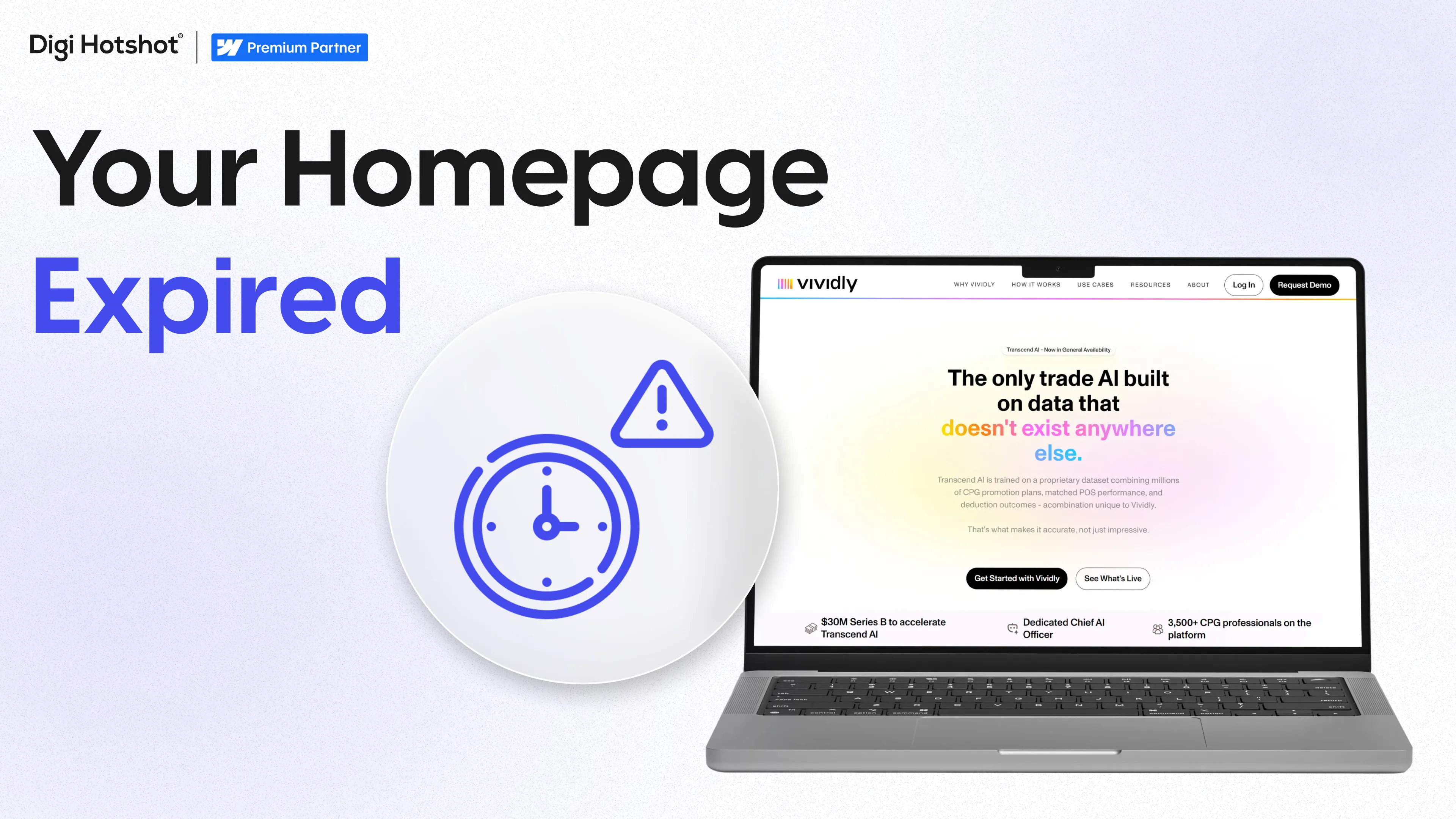


Quick answer: A homepage expires when your positioning matures past it, not when it breaks. Vividly's has been redesigned four-plus times in three and a half years, from Series A through a $30M Series B. The test isn't whether your page looks dated. It's whether it still describes the company you are now.
By Parth Gaurav, Founder & CEO, Digi Hotshot. Last updated: August 6, 2026.
Think about the last time your homepage was signed off. Three rounds of comments from sales, from the founder, from whoever owned the category story that quarter. Everyone eventually agreed on a headline, and it was a good headline, because it was true.
Then the company kept going. You shipped things that weren't on the roadmap when that headline was written, pricing changed shape, sales started closing a different size of deal with a different job title in the room. And the homepage still opens with the sentence that was true when you raised.
Nothing broke. Nobody got it wrong. The page just stopped describing the company, and that gap is close to invisible from the inside, because you read your own homepage the way you read your own signature. You don't actually see it anymore.
Vividly is a trade promotion management platform for CPG brands and a Digi Hotshot client since 2022. The full build story is in the case study post and on the Vividly case study page, so I'll stay on the one part that's useful to you.
Their homepage has been redesigned four-plus times in that stretch. Each version refined the messaging, improved the conversion paths, and reflected product capabilities that didn't exist in the version before it. Every one lines up with the company becoming something different:
One honest note on causality. The website evolved alongside those milestones, it didn't cause them. The only performance claim available is the soft one their CEO Alexander Whatley made himself after the original 2022 launch, that they saw marked spikes in traffic and more inbound leads than ever. Self-reported, and about the first launch, not any redesign since. There's no lift percentage to hand you here and I'd rather say that than make one up.
This is the part you can run against your own site this afternoon. A homepage doesn't go stale on a schedule, it goes stale on events, and you almost always know which event happened.
Be honest about how many of those have happened to you in the last eighteen months. If it's two or more and the homepage hasn't moved, the page is describing a company you've outgrown. That's not a design problem and it won't show up in a heatmap. It's also usually the two-audience problem underneath, where the page your investors approve of and the page your buyers need have quietly stopped being the same page.
The cost people budget for is the redesign. The cost they actually pay is the months of running a page that undersells them, while sales quietly works around it with decks and one-off docs.
The reason it slips is almost never denial. From what I've seen, a homepage change has been priced in everyone's head as a project, and a project means a kickoff, a stakeholder round, a design cycle, an engineering sprint, a QA pass. Nobody wants to spend a quarter on it, so it waits for a reason big enough to justify one, usually a rebrand or a round. The page catches up in one big jump, twelve to eighteen months late. If you're at that point already, the five-step redesign roadmap is the structured version and the ten-signs post is the faster diagnostic.
Here's the argument, and it holds whether or not you ever work with us. A company that needs a quarter and an engineering sprint to change its homepage will not redesign four times in three and a half years. It'll redesign twice, both times late, and run an expired page in between. The frequency isn't a matter of taste or budget, it's a function of what a change costs.
With Vividly, the standing turnaround on requests is two to three days, on a Webflow build with component-based architecture, so a new section gets assembled from parts that already exist rather than built from zero. Headline, CTA and layout decisions get tested through Webflow Optimize instead of argued about. Fifty-plus major projects over the partnership, and the marketing team can ship most of them without waiting on anyone's sprint.
So basically, the platform decision and the positioning decision are the same decision, separated by about a year. What you build on sets the price of being current, and that price sets how often you're willing to pay it. Webflow for SaaS teams covers the mechanics, and these five questions are a decent way to test how much autonomy your team actually has today.
Open your homepage. Not to critique the design, and not to redline the copy. Read the H1 and the subhead and ask one question: is this the company we are, or the company we were when we wrote it?
If you hesitate, you already know.
There's no correct interval. Homepages expire on events, not on a calendar. Funding rounds, pricing changes, moving upmarket, a category shift, a competitor reframing the space, or a rebrand. Vividly's has changed four-plus times in three and a half years because the company changed that many times. If nothing about your positioning has moved, neither does your homepage need to.
Compare three things: your current H1, the deck your sales team actually uses on calls, and the last board update. If the language in those three doesn't match, the homepage is the one that's behind. Sales decks update themselves informally, websites don't.
Changing messaging on a page you already own is different from changing URLs. Rankings get damaged by broken redirects, removed pages and lost internal links, not by rewriting a hero section. Keep the URL structure stable, keep the redirect map clean, and iterating on copy is a low-risk exercise.
No, and treating it that way is exactly why homepages sit expired. On a component-based build, the homepage can be reworked on its own and the rest of the site inherits the changes gradually. Vividly's homepage moved several times while other parts of the site were on their own schedule.
Three things. A component library so new sections are assembled rather than built, a CMS the marketing team can edit without a developer, and a testing setup so headline and CTA decisions are settled with data instead of opinion. Get those in place and a homepage refresh becomes a two to three day job instead of a quarter.
We do a free website audit where we look at your site the way a buyer in your category would, including whether the positioning on the page still matches the company behind it. No pitch attached, and you get the notes either way. If it turns out your homepage is fine, that's a useful thing to know too.
Last Updated:
August 12, 2026
Book a 30-minute discovery call. We'll discuss your current challenges and show you exactly how we can help.
Your competitors aren't stuck in developer queues. They're launching campaigns, testing messages, and capturing market share while you're waiting for simple updates.
Eliminate the bottlenecks. Give your marketing team the infrastructure they deserve—fast, autonomous, built to scale.