Est. 2019
Est. 2019
Real Estate Sai Hai is a free property listing site for Dehradun, Rishikesh, Haridwar, Roorkee, Vikas Nagar and Tehri Garhwal in Uttarakhand, where owners list plots, flats, houses and land for buyers to find.
Design By

Last Updated:
November 18, 2026

Parth Gaurav
Founder & CEO

Real Estate Sai Hai is a free property listing site for Dehradun, Rishikesh, Haridwar, Roorkee, Vikas Nagar and Tehri Garhwal in Uttarakhand, where owners list plots, flats, houses and land for buyers to find.
Webflow Development
Website Re-design
Strategy
Finsweet Attributes
Webflow SEO Optimisation
November 2026
Rebuild a listing site that already had Google traffic so it answers what Uttarakhand buyers search for: city, locality, property type and budget. Keep every ranking URL intact. And build it with an AI agent doing the page work, while a person approves every design and every publish.
Nine page types built in Webflow by an AI agent working from Claude Code through Webflow's MCP server, in under two days of build time: home, property search, listing, locality, city, guides index, guide, about and contact. Projects and list-your-property pages followed, along with seven buyer guides and written content for 25 localities and 6 cities.
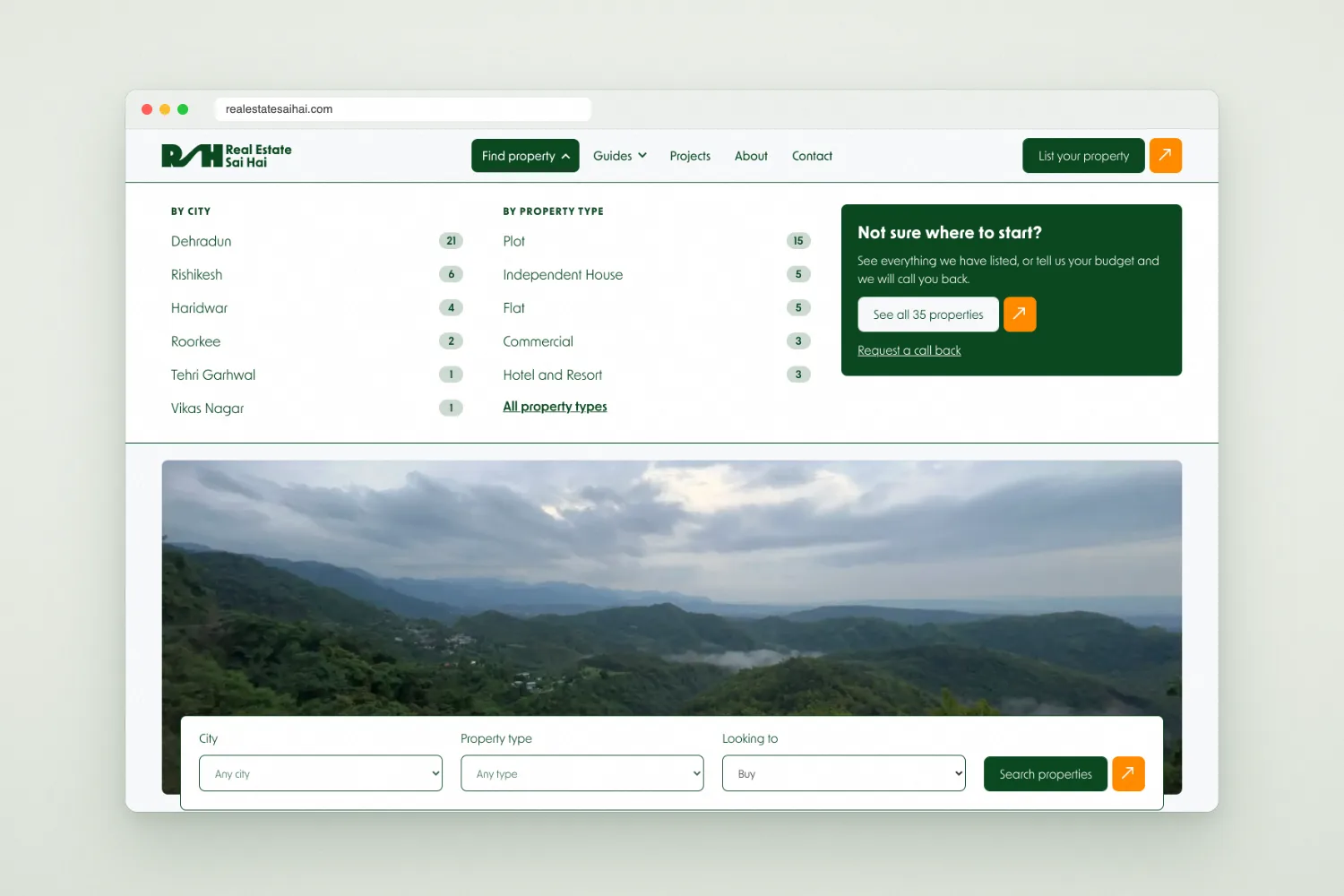
Before the rebuild, the site was a list of 35 properties. There were no city or locality pages and nothing that answered a buyer's questions. On the new build, a buyer can filter every listing by city, type, budget and sale or rent, open a page for their locality or city, and read a guide on land units, stamp duty or approvals before they enquire. Across 28 pages on staging, the new build averages 96 for desktop performance and 87 for mobile, with accessibility and best practices at 100, and pages like list-your-property score 100 on desktop and 97 on mobile.
Over the last 16 months, Real Estate Sai Hai had picked up 1,070 clicks and 65,100 impressions on Google, from people looking for plots, flats, land and farmhouses around Dehradun, Rishikesh and Haridwar. One ashram listing alone brought 271 clicks. But the site was built as a list of 35 properties, and most of them had been added between November 2023 and January 2024.
The numbers showed where it was losing. A plot listing in Dunga was shown 16,979 times and clicked 0.5% of the time. A 3BHK flat page was shown 9,516 times and clicked 0.1% of the time. Searches for 3BHK flats in Dehradun alone drew around 7,000 impressions, alongside houses, plots, farmhouses and Roorkee, and the site answered every one of them with an individual listing. Nothing gathered every option in one place.
The traffic was there, but the site had nowhere useful to send it, so the decision was to rebuild every page. We built it the way we now run our Webflow work: an AI agent builds each page on Lumos, an established Webflow component framework, and a person approves the design and presses publish themselves.
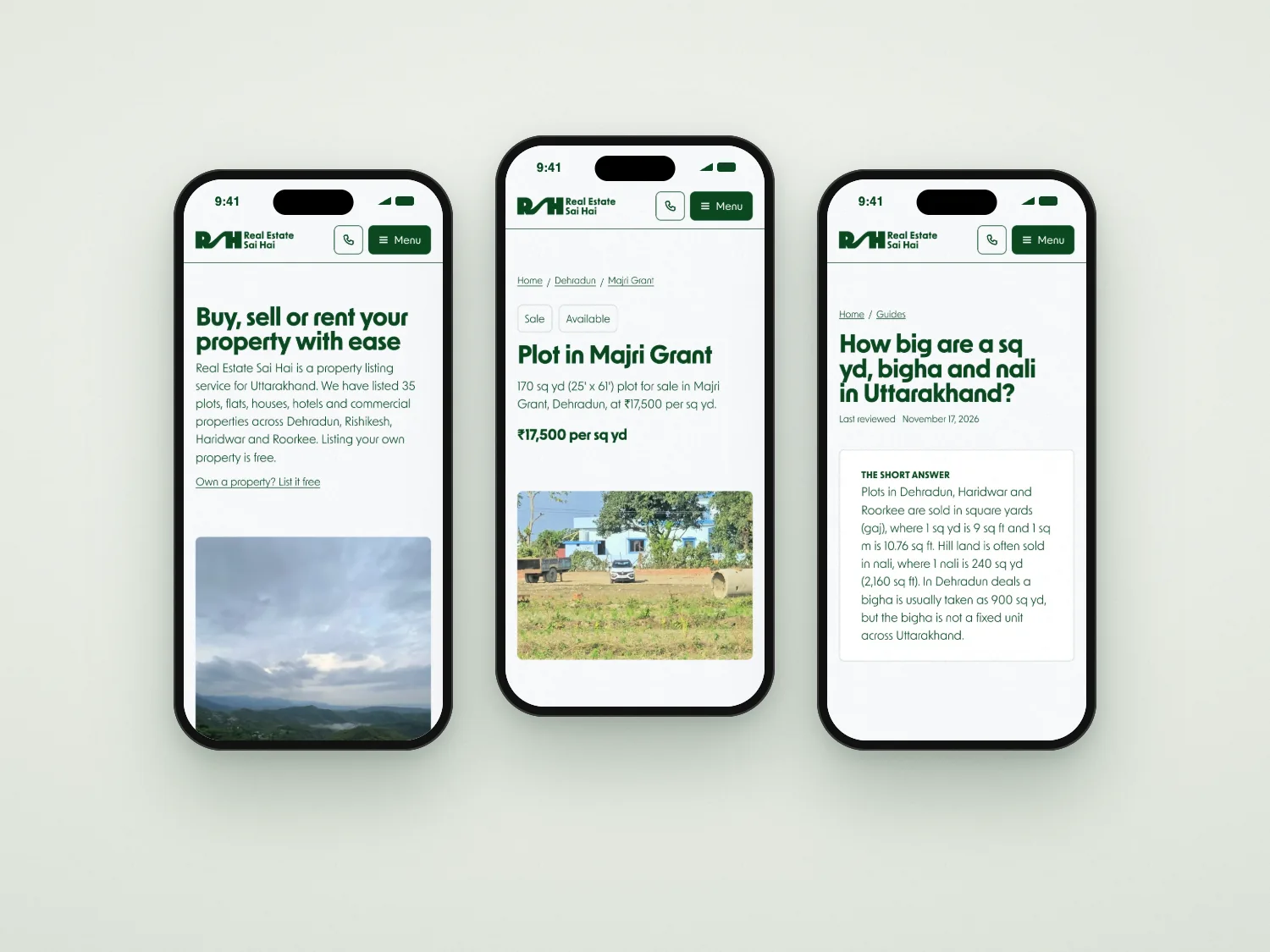
Before any design, we read the Search Console data, all 35 listings and the searches behind them. Three problems came out of it.
Someone searching for a plot in Majri Grant or a flat in Dehradun wants every option in that place, not one listing. So we recommended a page for every locality and city, each showing only the listings it actually has. Each of the 25 locality pages got an intro, nearby landmarks, questions and answers, and a typical rate wherever a listing states one. The 6 city pages got an intro, listing counts and their own questions, all written only from facts already in the CMS. Four of the old "localities" were really cities, so those pages are set to noindex rather than competing with the real city pages.
Buyers here think in lakh and crore, and some plots are priced per square yard. We added a price label to every listing ("₹56 lakh", "₹17,500 per sq yd") and budget bands from under ₹50 lakh to above ₹5 crore, so search filters by budget the way a buyer says it. The filters run on Finsweet Attributes, and the city, type and budget options come straight from the CMS.
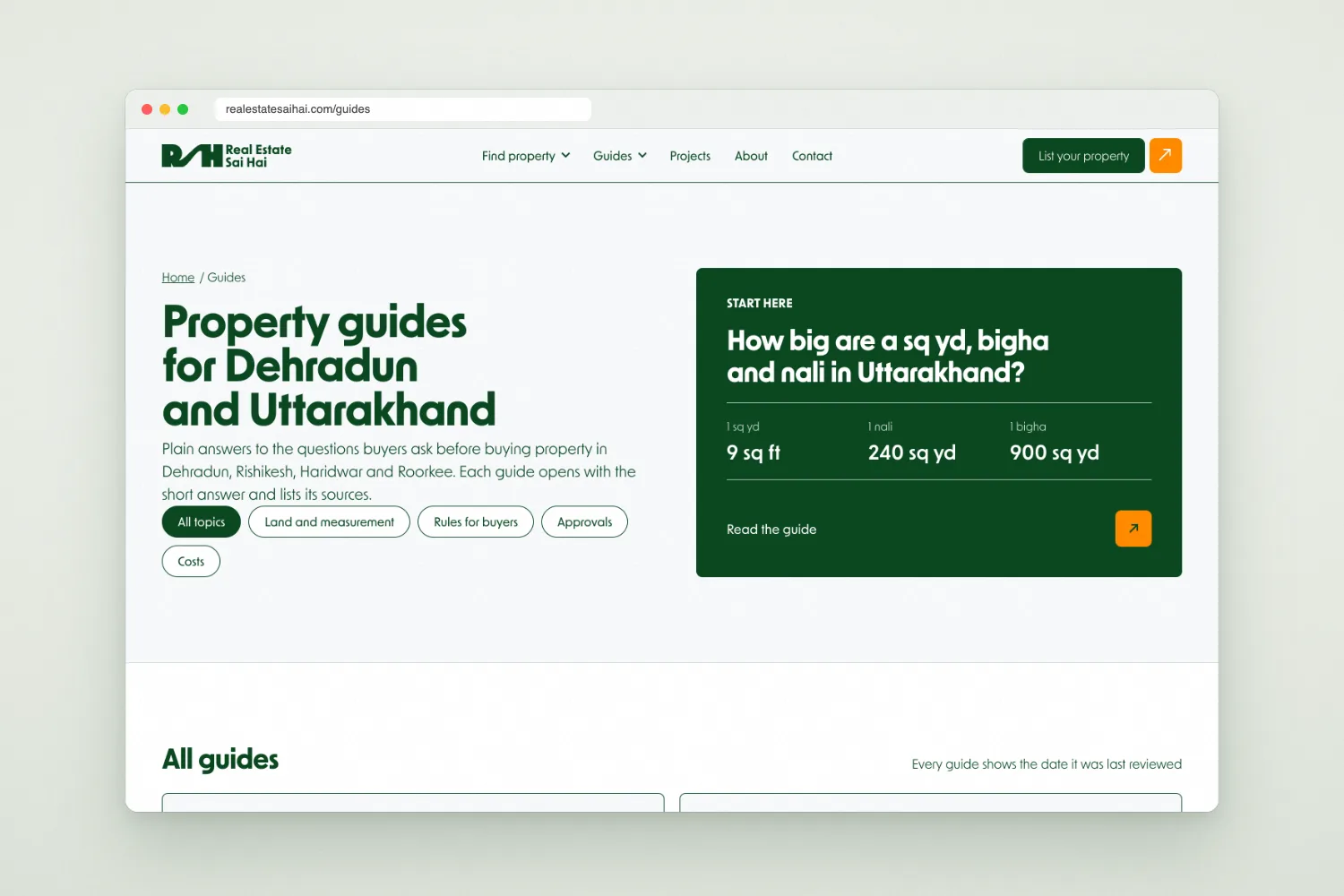
Land deals in Uttarakhand raise the same questions every time: what a nali or a bigha is, what stamp duty costs, which approvals a plot needs, whether someone from outside the state can buy farmland. We wrote seven guides, each in question-and-answer form so AI search can lift the answer, and cited government sources wherever one exists.
The site already ranked, so moving to a fresh Webflow project would have put every URL people found it through at risk. We recommended the harder route: bring Lumos into the same live Webflow project and rebuild each page in place, with the old pages kept as drafts until each new one was checked. Every existing URL is kept.
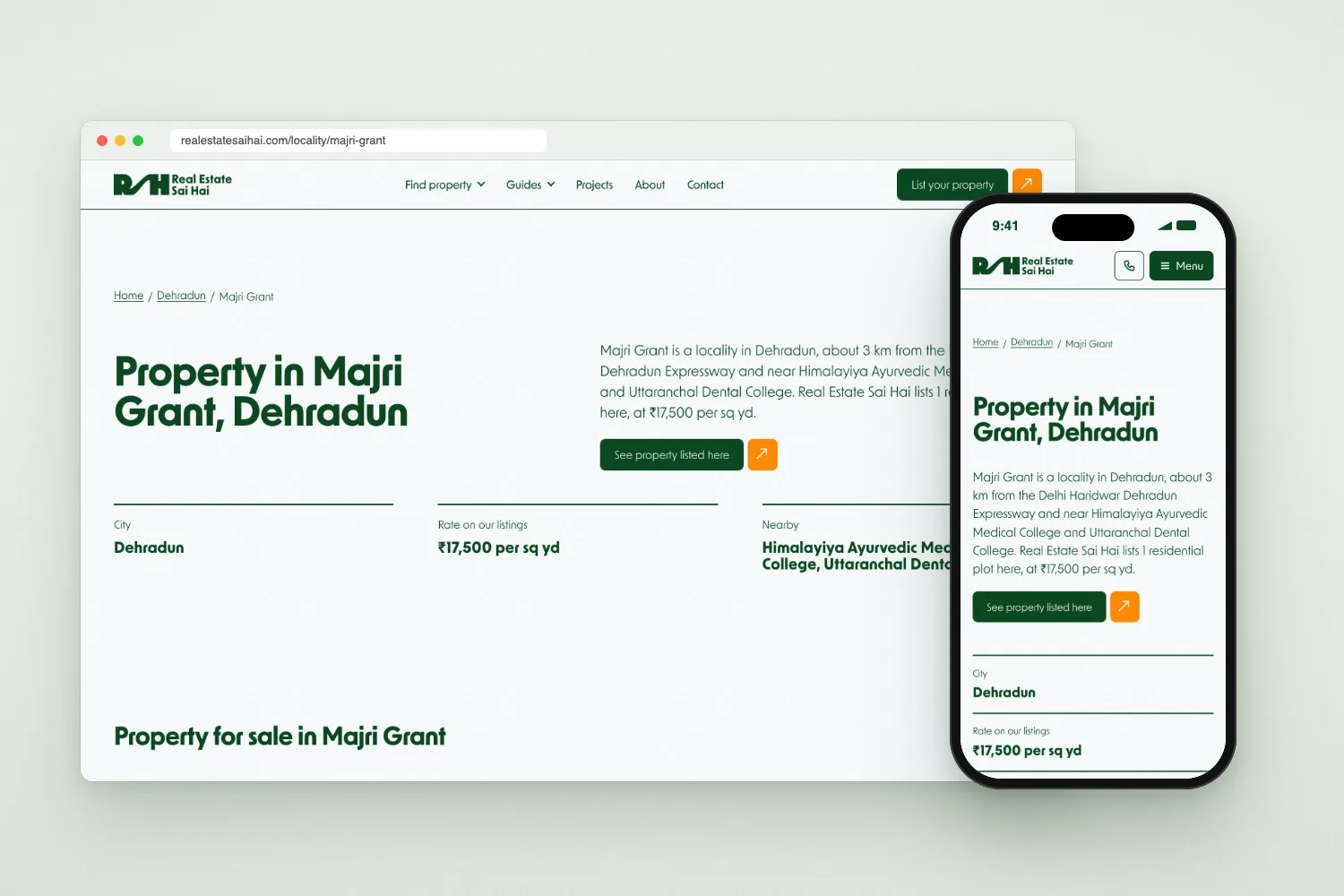
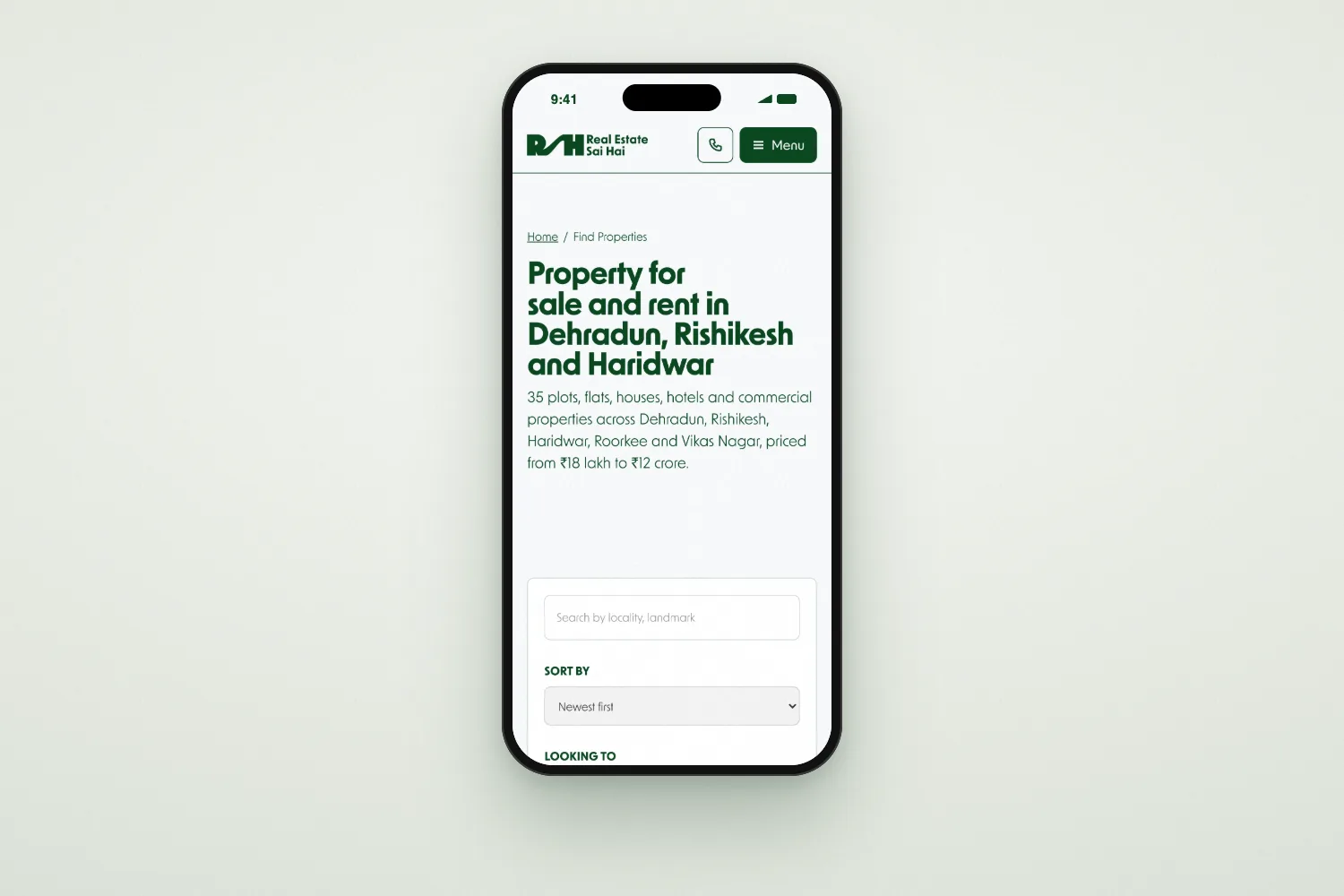
Every page started as a design in a shared canvas, drawn from real CMS data, with anything unknown left in brackets instead of guessed. A person approved it, then the agent built it in Webflow as a draft through the MCP server: the elements, the CMS bindings, the filter wiring and the structured data. The one time we skipped the design step, on the small guides index page, the build came out weak, so we designed it properly and rebuilt it. After that the rule applied to every page, whatever its size.
The agent couldn't do everything. A few settings the MCP server doesn't support, like filtering a list to the locality being viewed, were finished by a person in the Webflow Designer. Builds were checked in preview, the key templates at phone width too, and the filters were tested there before the first staging publish.
Once the pages were built, the six city illustrations were generated with an AI image model and cut from about 1.8 MB to about 90 KB each, and the home page photo went from 678 KB to 77 KB. Each page type got its own structured data: listings as real estate listings, localities and cities with FAQ schema, and guides as articles. Repeated sections like the FAQ, page hero, call to action and steps then became shared components, so the next page is quicker to build than the last.
Buyers now get a page for their city, their locality and their question, not just a single listing, and a new listing shows up in search and filters as soon as it's added to the CMS. Owners list through a form that asks for the map pin of the property and a confirmation that they're allowed to list it. The search baseline from before the rebuild is saved, so the three months after go-live will show what the new pages earn.
It's also how we now build Webflow pages for other teams: the agent does the build work, and a person owns every design decision and every publish.

Digi Hotshot designed each page in a shared canvas, then an AI agent built it in Webflow from Claude Code through Webflow's MCP server, on the Lumos component framework. A person approved every design before release, finished the few steps the MCP server can't do, and did every publish. Nine page types were built in under two days.
Yes, with guardrails. On Real Estate Sai Hai, the agent built pages, CMS bindings, filters and structured data as drafts. It never published. A person approved the designs, checked each build in preview, and finished anything the MCP server doesn't support in the Webflow Designer.
Buyers can filter every listing by city, property type, budget in lakh or crore, and sale or rent, then open a page for their locality or city that shows only the listings there, with nearby landmarks and typical rates where a listing states one.
No. Digi Hotshot rebuilt the site inside the same Webflow project and kept every existing URL, because buyers were already finding the listing pages on Google.
Seven guides answer common Uttarakhand property questions: land units like nali and bigha, stamp duty and registration fees, approvals, circle rates, rules for buyers from outside the state, land use change under Section 143, and TDS for NRIs.
A New York-based art consultancy curating bespoke art programs for hospitality and commercial spaces worldwide, with installations at The Spiral NYC (Hudson Yards), St. Regis Macao, The Joseph Nashville, JW Marriott Nashville, and MGM Springfield.
Build
Migrate


In collaboration with
Label Maker

A whole-food protein bar brand founded by former investment bankers who pivoted to wellness. Made with real ingredients, no artificial sugars, no preservatives. Launched with a two-phase Webflow + Shopify build — coming soon page live in under one week, full e-commerce site within 8 weeks. Partnered with Label Maker for brand identity and Digi Hotshot for Webflow development and Shopify integration.
Build
A Vista, CA-based defense-tech startup building the world's first AI-native ERP for advanced manufacturing, founded by military veterans and operators from Shield AI, Northrop Grumman (F-35 program), Apple, and MIT—backed by Context Ventures and Shield Capital.
Design
Build