
Est. 2019
A Vista, CA-based defense-tech startup building the world's first AI-native ERP for advanced manufacturing, founded by military veterans and operators from Shield AI, Northrop Grumman (F-35 program), Apple, and MIT—backed by Context Ventures and Shield Capital.
Design By

Last Updated:
November 20, 2026

Parth Gaurav
Founder & CEO
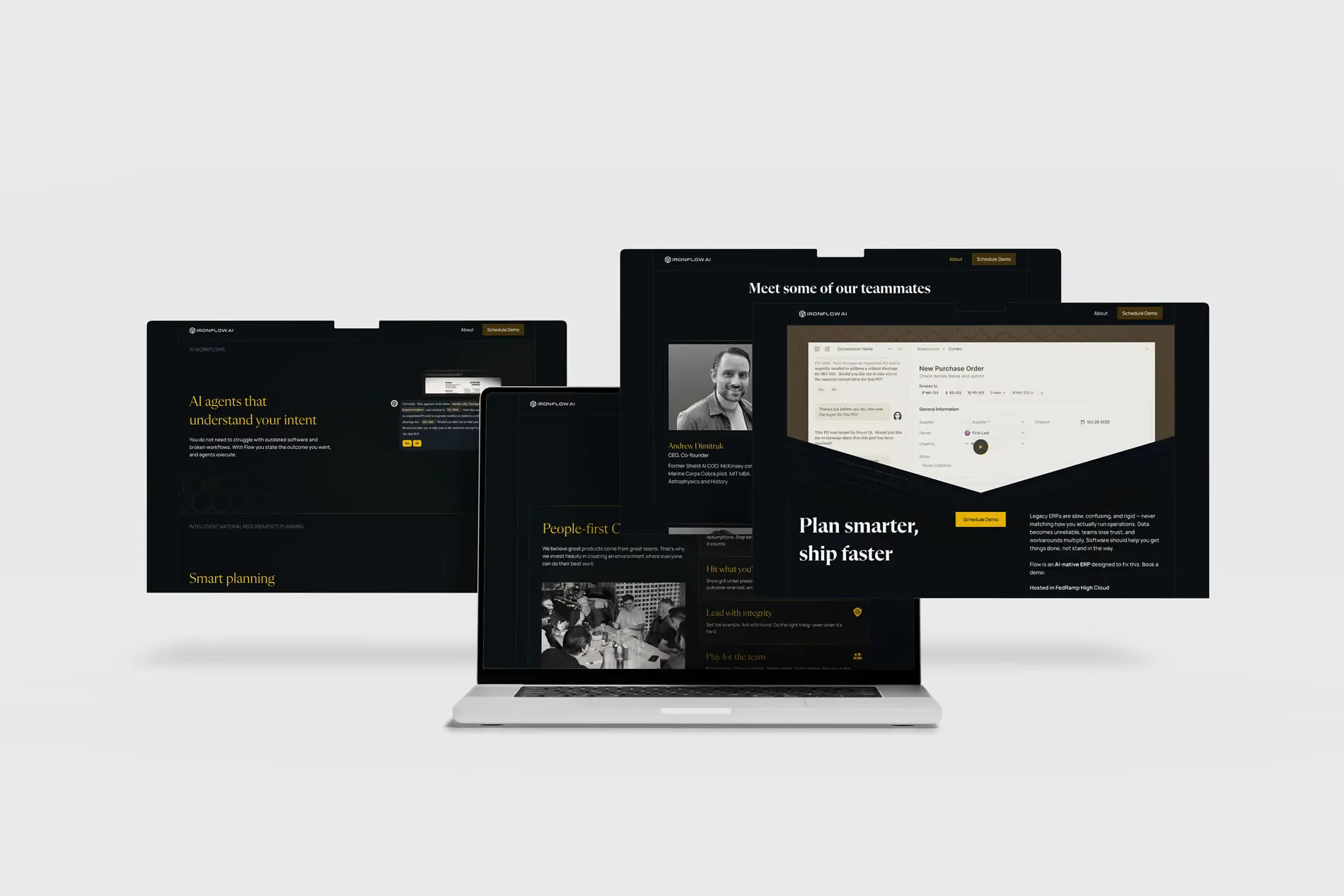
Ironflow AI was exiting stealth with a hard deadline—and a placeholder site that didn't match their ambition. They needed a digital presence that would instantly signal enterprise credibility to customers, candidates, and investors. We delivered a complete website design and Webflow build in two phases: a polished 7-section homepage by launch day, followed by custom Rive animations and an About page. Their marketing team now has full control to iterate without developer bottlenecks.
Strategy
Website Re-design
Webflow Development
November 2025
Help Ironflow AI exit stealth mode with a digital presence that signals enterprise credibility to customers, candidates, and investors. With their October 25th deadline immovable, they needed a website that would immediately communicate: "These people are building something exceptional." The challenge was delivering startup speed with enterprise-grade polish—a site that reflects both their innovative approach and deep industry expertise.
Complete website design and Webflow development delivered in two strategic phases. Phase 1 launched a polished 7-section homepage with product video hero, demo request forms, and full analytics integration. Phase 2 added a comprehensive About page with team profiles, four custom Rive animations demonstrating product capabilities, and enhanced scroll interactions throughout. The site was transferred to Ironflow's account with team training for ongoing autonomy.
Successfully launched before the critical stealth exit deadline, providing Ironflow with an enterprise-ready digital presence that positions them as category leaders in defense-tech ERP. The website now serves as their primary conversion tool for customer acquisition, talent recruitment, and investor relations. Marketing has full control to update content without developer dependencies, enabling rapid iteration as the company scales.
Ironflow AI is building AI-native enterprise resource planning software for America's defense manufacturing sector. Their experienced team—operators who understand the factory floor—had developed a sophisticated product, but their digital presence didn't reflect their capabilities.
With their stealth exit deadline approaching in October 2025, Ironflow needed more than a website refresh. They needed a digital presence that would immediately signal to customers, candidates, and investors: "These people are building something exceptional."
The challenge was nuanced. Ironflow wanted to appear modern and fresh—like a startup that moves fast—while also conveying deep industry experience and enterprise-grade credibility. As they put it: "We're not some snot-nosed startup from a garage. Our team is experienced. We know this world."
Three distinct audiences needed to be served:
• Prospective customers evaluating Ironflow as their ERP solution
• Top talent assessing culture fit and mission alignment
• Investors conducting due diligence on market position
October 25th, 2025. That was the immovable deadline. Ironflow AI was exiting stealth mode, and their single-page placeholder sitesimply wouldn't cut it for the moment they stepped into the spotlight.
The stakes were clear: when prospects, candidates, and investors started researching Ironflow, their first impression would be the website. In the defense-tech ERP space—where existing solutions are plagued by complexity overkill, steep learning curves, and implementation nightmares—Ironflow needed to immediately differentiate themselves.
With just three weeks until launch, the team needed a partner who could move at startup speed while delivering enterprise-quality results.
Our 90-minute strategy session revealed critical insights about Ironflow's positioning and their target users' pain points. The defense manufacturing sector was struggling with what the team called "spreadsheet hell"—lost in endless spreadsheets trying to organize records, with existing ERPs offering complexity overkill and unused functionality.
But here's what made Ironflow's approach different: they didn't want to lead with pain points. As they articulated during our workshop, "We don't want the copy on our website to be too negative. Focus on solutions, not problems."
The brand personality crystallized: Modern. Cool. Efficient. Smart. Innovative. Sleek. Easy. But also experienced and knowledgeable—"fresh start up aesthetic with deep industry experience."
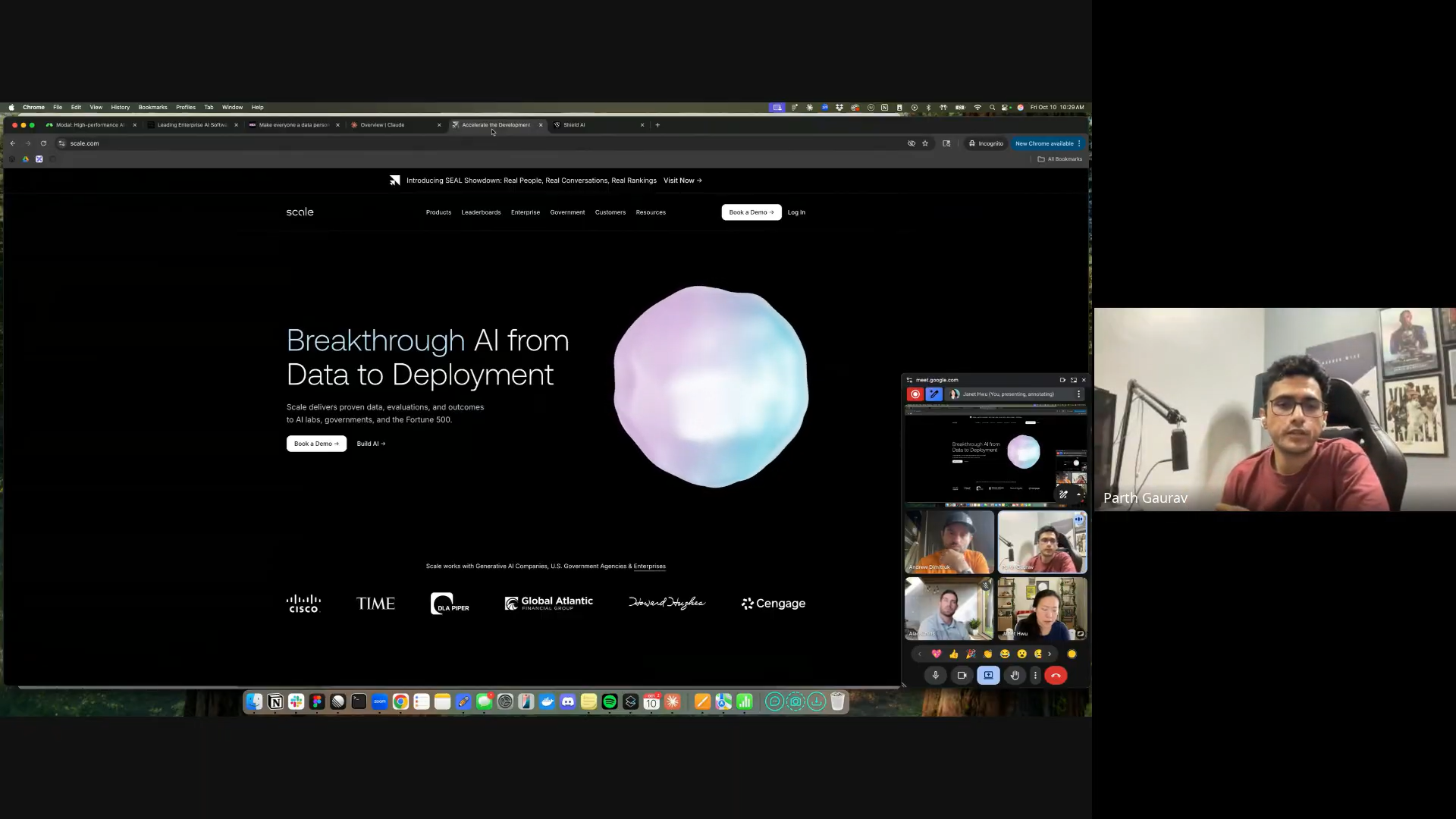
Finding the right visual language was critical. We explored numerous reference sites together—from Hex.tech's structured video hero to Noon.ai's dark mode animations—and established clear parameters:
• Dark mode preference with structured, formatted layouts
• Geometric grid lines evoking a blueprint aesthetic
• Real product screenshots over abstract concepts
• Minimal isometric graphics for manufacturing context
• Product-focused hero with clickable video demo
The team was emphatic: "I would love for them to see a screenshot or video right away and think 'I want to use that software.'" Everything else—the copy, the animations, the layout—needed to support that primary goal.
One pivotal decision emerged around the headline. The team initially considered "AI native ERP for defense manufacturing," but realized this might exclude non-defense visitors. The final positioning—"AI native enterprise resource planning software for the factory"—spelled out the ERP acronym for broader accessibility while keeping the scope intentionally open.
Feature highlights were carefully curated to focus on benefits:
• Easy to use
• Agents that understand your intent
• Built-in compliance
• Fast setup
• Smart planning
• Open integrations
The two-phase strategy was our calculated bet. Rather than rushing a comprehensive site to market, we proposed launching a polished foundation by October 25th, then enhancing it with custom assets and animations by mid-November.
Phase 1 would deliver:
• Complete 7-section homepage with clean design
• Responsive Webflow development with CMS
• Demo request popup with audience segmentation
• Newsletter signup and analytics integration
Phase 2 would add:
• Custom Rive animations for product demonstrations
• Complete About page with team profiles
• Enhanced scroll-triggered interactions
• Performance optimization throughout
This approach aligned perfectly with Ironflow's "share early, share often" philosophy. As they told us: "Even if you give me a napkin diagram, I'd be comfortable with that." We embraced rapid iteration—mood boards within 3 days, hero section designed first for validation, continuous feedback via Figma and Slack.
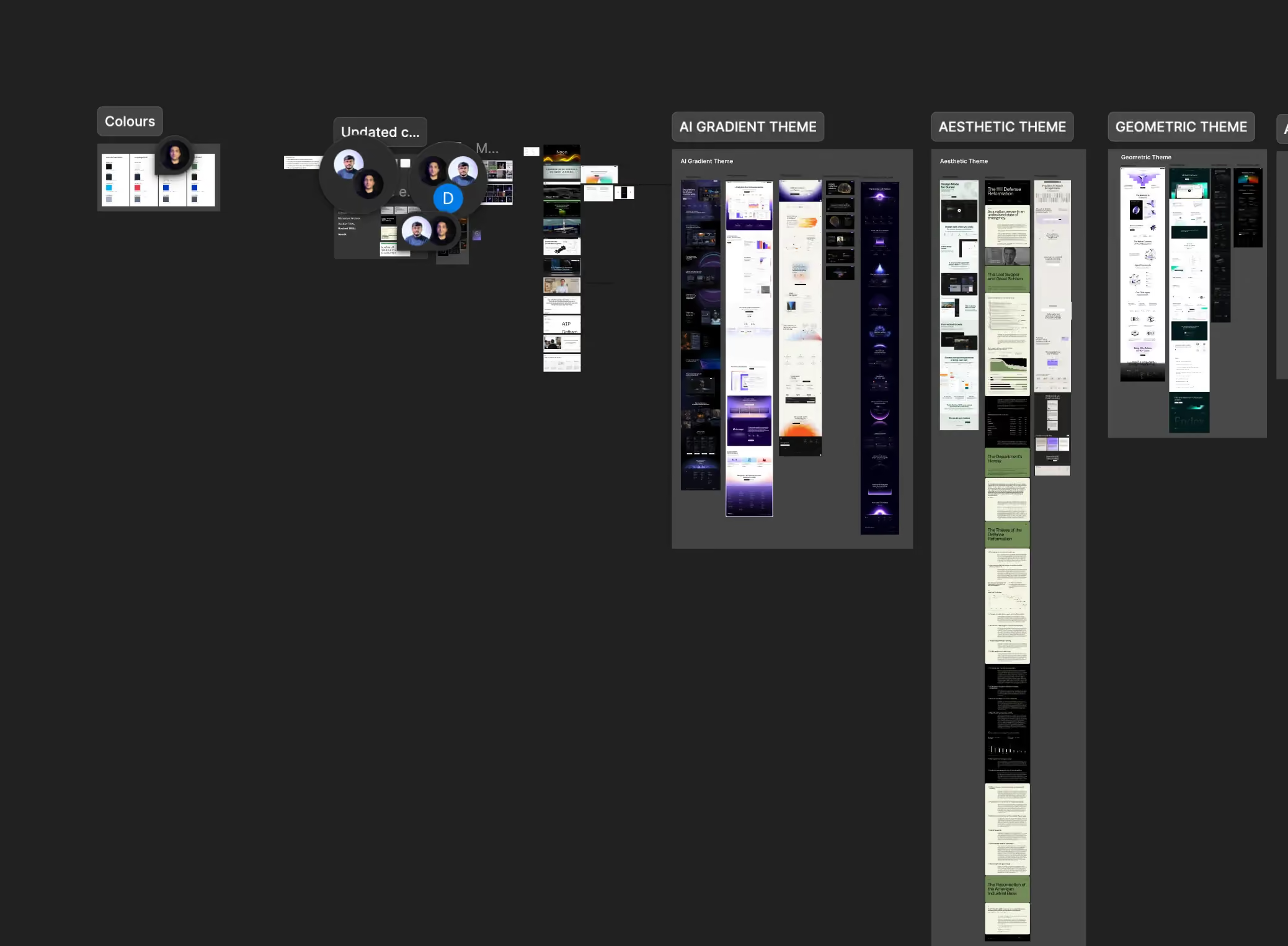
The design phase moved swiftly through validation checkpoints. Mid-fidelity wireframes established the information architecture. Multiple hero section variations were presented for feedback. The geometric grid pattern—inspired by blueprint aesthetics—required several iterations to achieve the right balance between visual interest and readability.
Janet Hwu, Ironflow's UX Designer, provided detailed feedback throughout, from form field behaviour to typography weight adjustments. The collaboration was genuinely two-way—she even created reference mockups in Figma to illustrate exactly how the hex background pattern should appear.
Development proceeded in parallel with design refinement. The Webflow build featured component-based architecture for easy future updates, structured CMS for content management, and seamless integrations with the client's existing tech stack.
Key technical implementations included:
• Google Analytics 4 for tracking and insights
• Apollo.io visitor tracking integration
• Content square heatmaps for user behaviour analysis
• Dual form system differentiating "Contact Us" from "Schedule Demo" submissions
• Newsletter signup with customer/investor segmentation
No project of this complexity runs without hurdles. An AWS outage on October 21st required delaying publication. Gradient colour banding in backgrounds demanded technical solutions. The demo request form required multiple refinements—from search-select behaviour to tooltip styling conflicts with the dark theme.
Each challenge was addressed through rapid communication via our dedicated Slack channel, with solution soften implemented within hours of identification.
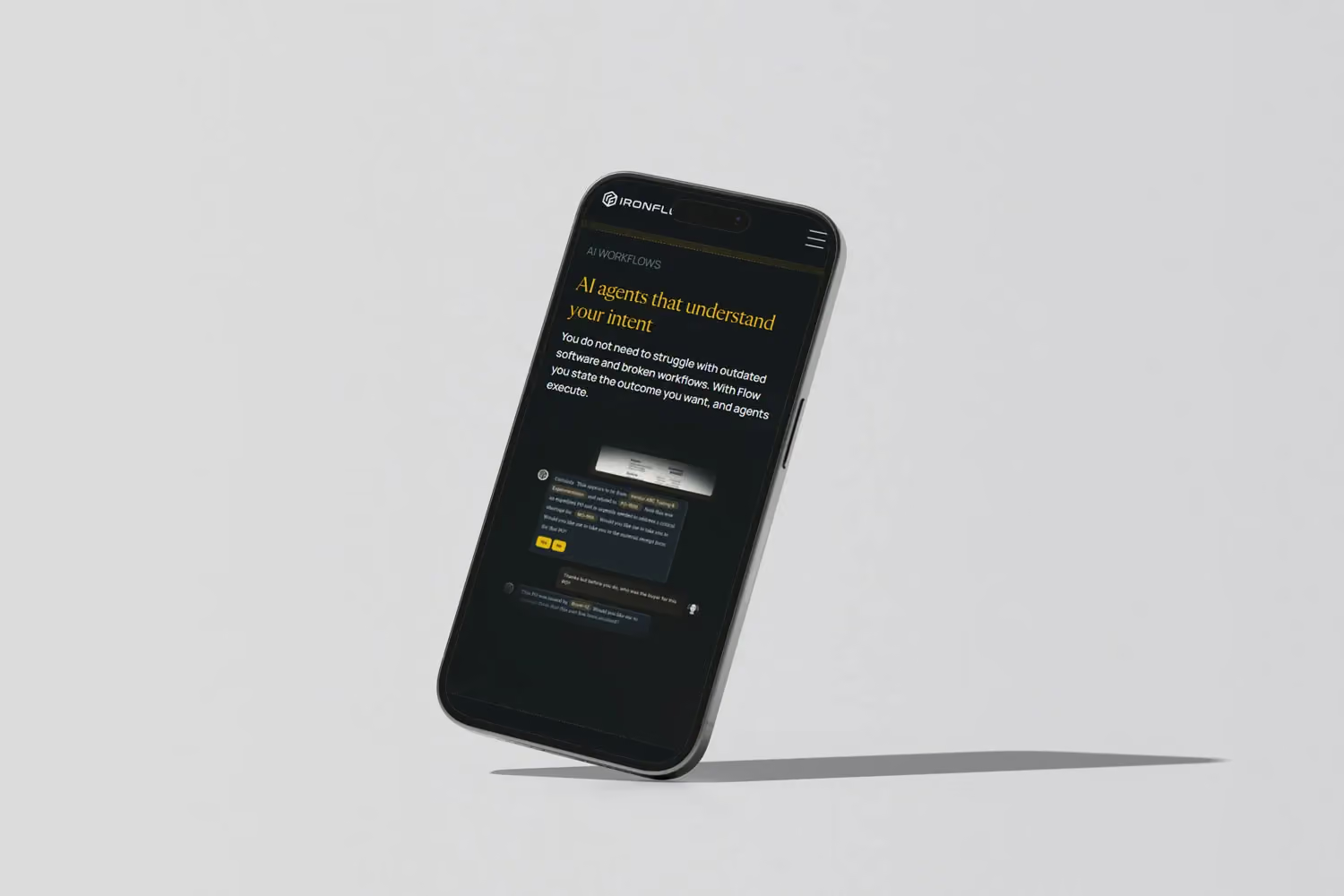
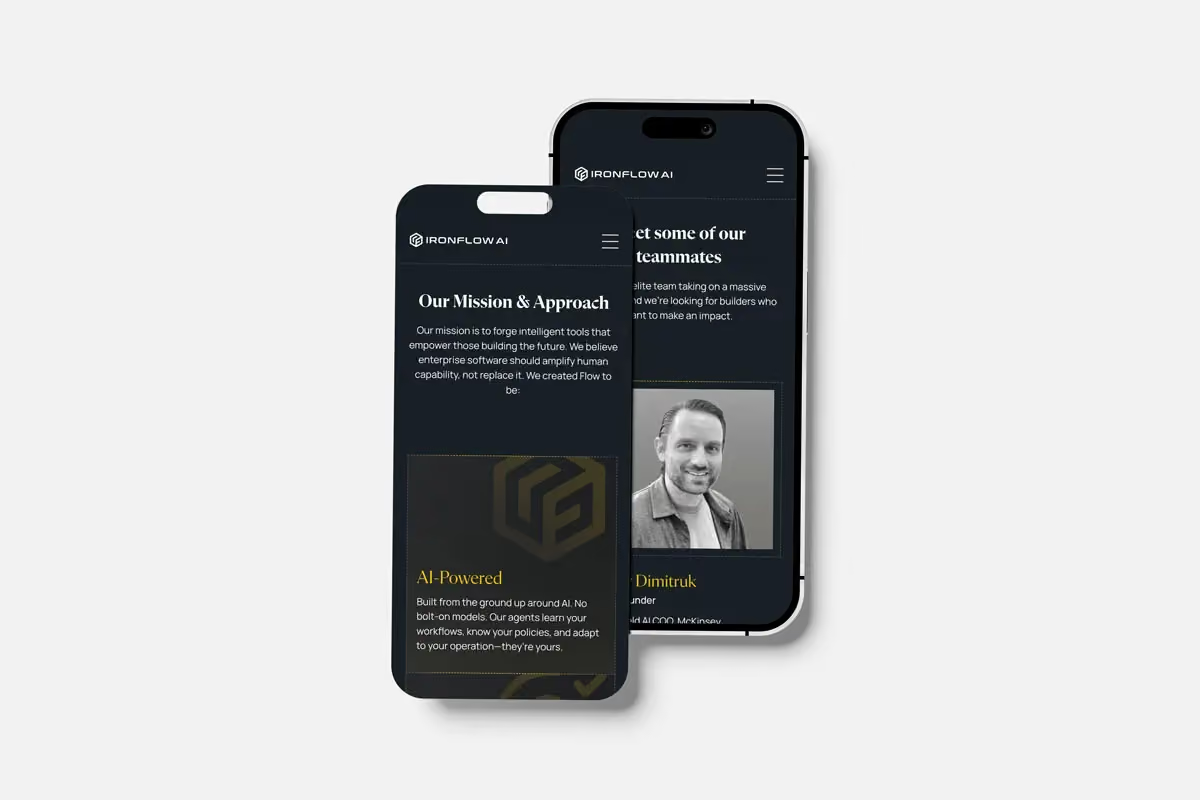
Phase 1 launched on November 2nd, 2025—meeting the critical stealth exit window. The homepage featured all seven planned sections: hero with product video, problem/solution framing, product overview with Rive animation, how it works, social proof section (designed and ready for future testimonials), mission/vision, and conversion CTAs.
Phase 2 completed on December 2nd, 2025, adding the About page with team profiles, four custom Rive animations demonstrating product capabilities, and enhanced on-page animations throughout. The site was transferred to Ironflow's Webflow account, with the team trained on content updates.
• 7-section homepage with dark mode design and geometric grid aesthetic
• Complete About page with team profiles, mission, culture, and careers section
• 4 custom Rive animations for product demonstrations
• Responsive design across all devices
• Demo request popup with audience segmentation
• Full analytics and tracking integration (GA4, Apollo)
• Team training for ongoing content management
"Appreciate the effective communication from your whole team and everyone's responsiveness to our comments throughout this effort. It was a great experience of remote collaboration for me. Hope to work together again in the future."
— Janet Hwu, UX Designer, Ironflow AI
The project exemplified what's possible when client and agency operate as true partners. Ironflow's clarity on positioning, willingness to iterate, and trust in the process enabled us to deliver exceptional results on an aggressive timeline. Their "share early, share often" philosophy matched our collaborative approach perfectly.
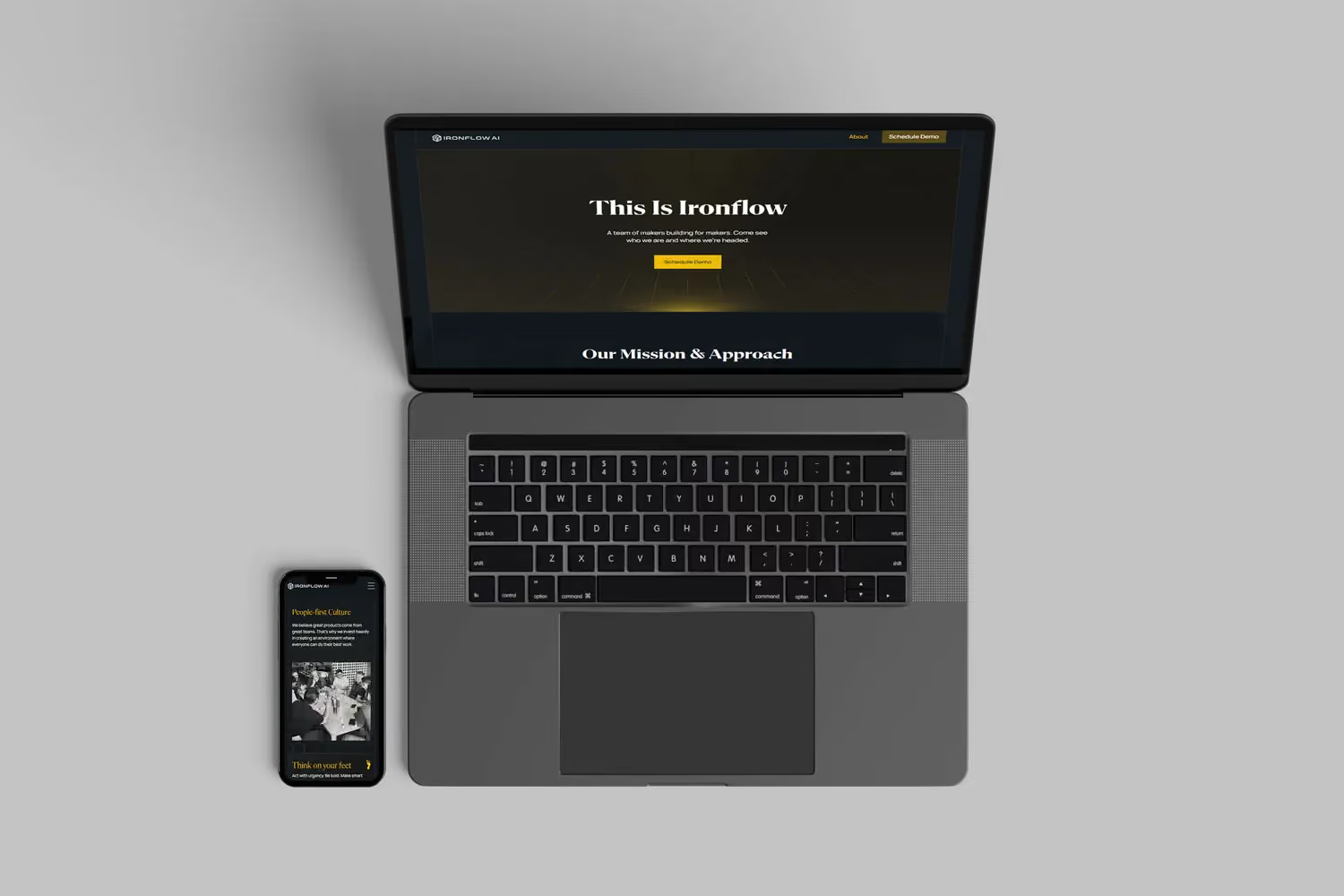
Digi Hotshot designed and built Ironflow AI's Webflow website in two phases around their exit from stealth. Phase 1 replaced a single-page placeholder with a 7-section dark mode homepage, a product video hero, a demo request popup and analytics, and went live on November 2, 2025. Phase 2, completed December 2, 2025, added an About page with team profiles, four custom Rive animations and scroll-triggered interactions. We then transferred the site to Ironflow's account and trained their team.
Ironflow AI's Webflow site, built by Digi Hotshot, connects to Google Analytics 4 for tracking, Apollo.io for visitor tracking, and Contentsquare heatmaps for user behavior analysis. A dual form system separates "Contact Us" from "Schedule Demo" submissions, and the demo request popup segments visitors by audience. The newsletter signup also separates customers from investors. Analytics, the demo popup and the newsletter signup all shipped in Phase 1 of the build.
Ironflow AI's site was built for three audiences at once: prospective customers evaluating an AI-native ERP, top talent assessing culture and mission fit, and investors doing due diligence. Digi Hotshot mapped those needs in a 90-minute strategy session before design began. The build then routes each group, with a demo request popup that segments by audience, separate Contact Us and Schedule Demo forms, a newsletter signup that splits customers from investors, and an About page covering team, mission, culture and careers.
Digi Hotshot designed Ironflow AI's site in dark mode with geometric grid lines that evoke a blueprint, reflecting their focus on advanced manufacturing. Real product screenshots won over abstract concepts, and the hero leads with a clickable product video, because the team wanted visitors to see the software right away. Minimal isometric graphics add manufacturing context, and four custom Rive animations show product capabilities. Janet Hwu, Ironflow's UX Designer, gave detailed feedback throughout, down to typography weights.
Phase 1 of Ironflow AI's Webflow site went live on November 2, 2025, after a build that started with just three weeks of runway before launch. Phase 2 followed on December 2, 2025. Digi Hotshot kept pace with mood boards within 3 days, the hero section designed first for validation, and development running in parallel with design refinement. An AWS outage on October 21 forced a publication delay, and fixes were handled quickly over a dedicated Slack channel.
Gateway X is a St. Louis fund founded by Jesse Pujji, who built and sold Ampush "the same way: profitable, founder-controlled, no venture treadmill." It describes itself as "the first residency and fellowship built for seedstrapping, the third path between venture and bootstrapping," and backs founders who want to build profitable companies they keep control of.
Build
A New York-based art consultancy curating bespoke art programs for hospitality and commercial spaces worldwide, with installations at The Spiral NYC (Hudson Yards), St. Regis Macao, The Joseph Nashville, JW Marriott Nashville, and MGM Springfield.
Build
Migrate


In collaboration with
Label Maker

A whole-food protein bar brand founded by former investment bankers who pivoted to wellness. Made with real ingredients, no artificial sugars, no preservatives. Launched with a two-phase Webflow + Shopify build — coming soon page live in under one week, full e-commerce site within 8 weeks. Partnered with Label Maker for brand identity and Digi Hotshot for Webflow development and Shopify integration.
Build