

Sanity Agency for B2B Teams
We're Webflow-first. When engineers own your website, or one set of content has to feed your site, docs and product, Sanity is the better platform. We build it so marketing can still ship a page without a ticket for every headline.

What a Sanity agency does for you
A Sanity agency designs and builds websites on Sanity, a headless CMS that stores content as structured data and leaves the website front end to be built separately. The agency models your content, sets up Sanity Studio for editors, builds the Next.js or Astro front end and moves existing content across.
Is Sanity right for your team?
Three questions decide it, and a fourth tells you when Webflow is the better home. Answer them for how your team works today.
1. Do engineers edit the site in a normal week?
Engineers can own the schemas, the front end and the upgrades.
2. Does your content feed more than the website?
Docs, product, apps and AI agents can all read the same content.
3. Do developers have time set aside for the site?
New sections and upgrades after launch need that time.
Then look at Webflow first. New layouts are built visually, and with Webflow's MCP server an AI agent can build pages from your existing components for a person to review. We build pages that way ourselves.
What your team can do without a developer
Most Sanity agencies say marketers can publish without developers. Here's where the line sits on a Sanity site built for editors.
We plan the section library around the pages you'll ship in the year after launch, so most new pages need no new code.

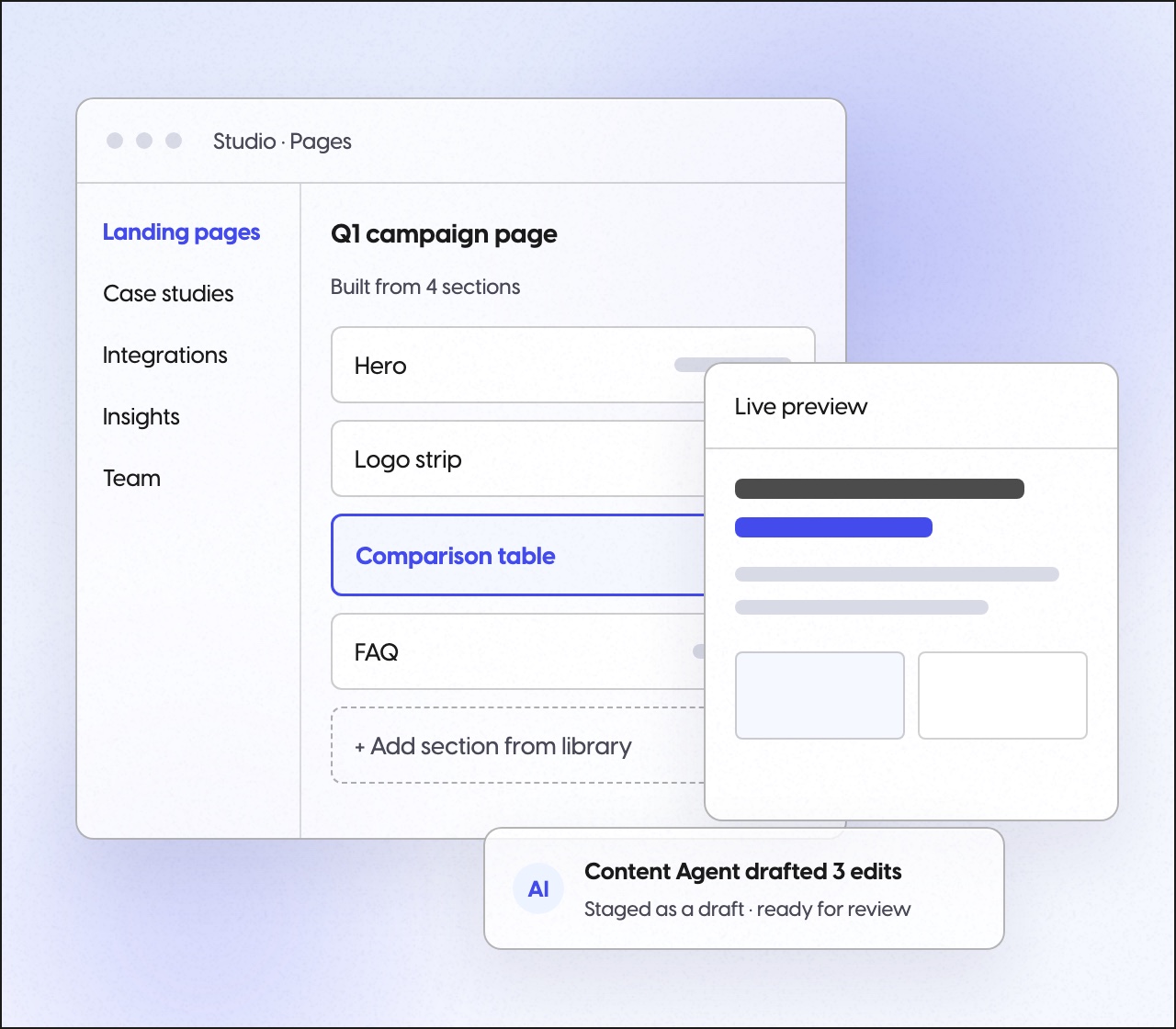
Edit any text, image, link or SEO field, and publish
Build a new landing page from the sections in the library
Preview changes on the real page before publishing
Have Sanity's Content Agent draft copy for someone to approve
Add posts, case studies and other records the model holds
A new kind of section, or a change to how one looks
A new field or content type
Forms, tracking and new integrations
Studio and framework upgrades
What does a Sanity build include?
Sanity hosts the Studio and your content. We build every layer around it for the people who edit.
Your editors
Writers, reviewers and publishers, each with the right role (on Sanity's Growth plan and up).
Sanity Studio
Menus arranged by job instead of by schema, with Visual Editing wired to a preview of your site.
Content model
Fields named the way your team talks, with descriptions and validation, so writers know what goes where.
Section library
Heroes, proof, tables, FAQs and CTAs designed as one system, so every new page stays on brand.
Front end on Next.js or Astro
In your repository, hosted on your platform. Forms post to your CRM or form tool, since Sanity has no built-in form handling.
We build the website. The same content can also feed docs, product and AI agents your engineers build.
Migration onto Sanity
No one-click import exists. Content is scripted across, rich text converted to Sanity's format, and every changed URL redirected. Moving from Webflow also means its interactions are rebuilt in code.
Languages
Set up per document or per field, depending on how your regional teams work. Sanity doesn't charge per locale.
What does Sanity cost to run?
A common regret with going headless is budgeting for Sanity and forgetting the rest. Here's every line, before you commit.
Sanity figures from sanity.io/pricing, checked November 17 2026. SSO, custom roles and audit logs are on Sanity's Enterprise plan.
Line
What to budget for
Content platform
Usage
Website hosting
New sections
Upgrades
Not sure which side you're on?
Bring your team and your site to a 30-minute call. You'll leave with a platform recommendation, even if it isn't Sanity.
A Sanity site still has to bring in leads
Our monthly growth work can run on Sanity sites too. The site keeps improving after launch, and you see what it brought in.

Found in search and AI answers
On a headless site, schema markup and redirects are set up in code. We keep them right and structure pages so they're easier for AI answers to cite.
New pages and sections
Campaign pages, new sections for the library and content refreshes, shipped as part of the month's work.

A monthly report on results
What we shipped, how search and AI visibility moved, and what the site brought in, so you know where to spend next.
How a Sanity project runs with us
Our usual website stages, with a content model and Studio stage added for Sanity. We plan Sanity builds at 6 to 14 weeks.
Strategy and structure
Parth runs the strategy session himself. We agree positioning and messaging, then walk the sitemap with you page by page. If the session shows Webflow suits your team better than Sanity, this is where you hear it.
Page strategy and wireframes
Every page gets a plan: its sections, their purpose and the call to action. We turn those into mid-fidelity wireframes with your real copy, so you approve structure and words before anyone designs.
Design, pages first
Our designer sets the visual direction on one page, you approve it, then it carries across the rest. The section library comes out of those approved pages, so every section exists because a real page needed it.
Content model and Studio
A first pass of content types is drafted with the sitemap. Once pages are approved, the sections and content types become Sanity schemas. We arrange Studio by job and set roles, and your team tries real publishing tasks in a working Studio.
Front end, SEO and integrations
We build the Next.js or Astro front end from the approved designs and connect Visual Editing to it. SEO is set during the build: schema, redirects and the sitemap. Forms, analytics and your CRM are connected and tested before launch.
Launch, handover and growth
Your content is scripted across, every redirect is verified at cutover, and we watch the first week closely. Everyone who edits gets training and a site management guide. Then the site moves into monthly growth work, if you keep us on.
Websites we've delivered
50+
Websites built since 2019
30+
Website migrations delivered
4+ yrs
Longest client partnership
85+
Pages on Sisu Clinic's site
"Ever since go-live, we've been seeing marked spikes in traffic and our inbound marketing initiatives are starting to bring in more leads than we ever saw on our previous site."
Zach Norton, Lead Product Designer, Vividly
We run the same loop on our own site
We started the work in March, and by June AI answer engines had started citing our pages. Today ChatGPT, Gemini and Google's AI Mode all cite us, and AI assistants now send visitors to our pages every week.


Vividly
Vividly: From Series A Rebrand to $30M Series B Trade Promotion Leader
Design and development partner for 3.5 years: 50+ projects and four homepage redesigns.
Design
Build

Atakama
Atakama: Strategic Webflow Redesign for B2B Cybersecurity Growth
Strategy-first redesign of their existing Webflow site, with HubSpot integration. Their CMO rated our work 5 out of 5.
Design
Build

Real Estate Sai Hai
Real Estate Sai Hai: A Property Search Site Built With an AI Agent on Webflow
Rebuilt by an AI agent from Claude Code through Webflow's MCP server: nine page types in under two days, then 31 city and locality pages and seven buyer guides, with every ranking URL kept.
Design
Build
Growth
What clients say after launch
Our longest partnerships started in 2021 and are still going. Here's what clients say about working with us, before launch and long after it.


It was an absolute pleasure working with Parth on the rebranded website for Vividly. We had worked with other webflow agencies previously and none of them offered the attention and expertise that he and the Digi Hotshot team brought to our project. He worked quickly with our internal teams to diagnose problems and address last-minute changes in a way that produced excellent outcomes. Ever since go-live, we’ve been seeing marked spikes in traffic and our inbound marketing initiatives are starting to bring in more leads than we ever saw on our previous site. I’m personally looking forward to the next project we work on with Parth and his team!


Zach Norton
Lead Product Designer
I’ve worked with Parth on a couple of Webflow projects and I highly recommend him. His work is consistently excellent, with quick turnaround times and attention to design polish. He’s gone above and beyond to fix issues and improve small details, always willing to help even after our website launched. I’ve recommended him in the past to several other founders and plan to continue working with him for future projects!


Alvaro Morales
Co-founder & CEO
It was a pleasure working with Parth and his team on our all-new website. The designs came out great, and the final execution was extremely high quality. Would highly recommend his team for any web/design project!


Erik Pakravan
Partner
They felt like an extension of our team. Digi Hotshot successfully over-delivered the project on time and within budget. They were highly organized and responsive to the client's requests via messages and virtual meetings. Digi Hotshot's collaborative attitude and straightforward approach were key elements of their work.


Drake Debiasse
VP Growth
Parth helped to implement our designs in Webflow in record time. We were on a time crunch because our rebrand efforts before our Series A announcement. Parth worked closely and diligently with our VP of Marketing, lead designer, and QA engineer to get the site built, tested, and vetted before launching it live. I'd highly recommend Parth to any other startup that needs to get a clean, professional site built on a timeline.

Alexander Whatley
CEO
@DigiHotshot was absolutely phenomenal in taking our Figma designs and turning them into reality on @webflow but what really makes him stand out is that he goes the extra mile way beyond the scope to deliver an A+ quality website and make sure it all goes smoothly. Thank you🙏


Michael Rouveure
Head of No-Code Operations
The Digi hotshot team was willing to jump in quickly and iterate flexibly as we found more definitions for the requirements. The site was delivered on time and according to specifications. Digi Hotshot worked quickly and flexibly to meet the client's needs. The team was responsive and receptive to feedback.


Jay Ashe
VP of Technology
Working on Webflow assignments with Parth is a blessing. He really knows all the ins and outs of the platform. It’s amazing to see what he can deliver with almost no briefing.


Yannick Khayati
Founder
Learn more about Sanity and headless CMS


Sanity projects: Frequently Asked Questions
Sanity is a headless CMS. It stores content as structured data and delivers it by API to a website, docs, apps or AI agents, while editors work in Sanity Studio. B2B teams use it when the same content has to feed more than one place, or when engineers want the site in the same code stack as the product.
It designs your content model, sets up Sanity Studio for your editors, builds the sections they assemble pages from, builds the website front end that reads from Sanity, and moves your existing content across. We also keep improving the site after launch.
Yes. Webflow is our default for B2B marketing sites, because most marketing teams want to publish without developers. When engineers own the site, or your content has to feed docs, a product or several sites, Sanity fits better, and we'll build it on Sanity.
It mostly depends on who runs the site. If marketing owns it and nobody builds front ends, Webflow. If engineering owns it, or the same content feeds more than the website, Sanity. Four things decide it: who edits in a normal week, whether content feeds more than the website, whether developers have time for the site, and how often marketing needs new layouts.
Yes, from the sections in the library. Editors change text, images and SEO fields, build new landing pages and preview them on the real site. A new kind of section, a new field or a design change still needs a developer, which is why we plan the library around the pages you'll need in the year after launch.
Yes. Visual Editing and the Presentation tool are on every Sanity plan, including Free. Editors click on the page and edit the content behind it. It needs a running front end to work, which we build and connect.
Both have official Sanity support. Astro sends very little JavaScript, which suits content-heavy marketing sites. Next.js suits sites with logged-in areas or heavier interactivity. With Astro, live preview needs the preview site to run server-rendered. We choose with your engineers, based on what they'll maintain.
Yes, we take on moves from WordPress, Webflow and other platforms. There's no one-click import, so content is scripted across, rich text is converted to Sanity's format, and every changed URL is mapped to a redirect before launch. Moving from Webflow also means its interactions are rebuilt in code.
Rankings can move for a few weeks while Google recrawls the new URLs. That's normal for any migration. A one-to-one redirect map, carried-over metadata and monitoring after launch bring them back, and we fix any page that slips. Changing platform, design and URLs at once raises the risk, so we plan which changes go first.
Sanity's Free plan covers up to 20 seats, but only with admin and viewer roles and public datasets, so most business teams start on Growth at $15 per editing seat a month (view-only seats are free), with usage limits on documents, API requests and bandwidth. Hosting the website is a separate bill. Prices as of November 2026, from sanity.io/pricing. Our side is scoped on a discovery call, with a fixed scope and a clear number before anything starts.
We plan them at 6 to 14 weeks. The range depends on how many page types and sections you need, how complex the content model is, and whether we're moving an existing site with its content and redirects. Feedback speed on your side matters as much as ours. You get a timeline at kickoff.
Sanity's Content Agent is on every plan. It can draft and edit content across documents, and every change is staged as a draft for a person to review and publish. On Sanity's Growth plan, a Contributor role can draft without publishing, so we'd set roles up so nothing goes live unchecked.
For most reviews, yes. Sanity is SOC 2 Type 2 certified and GDPR compliant. Single sign-on with SAML, custom roles and audit logs are on its Enterprise plan. On our side, we'd keep the dataset private (Growth plan and up) and keep write tokens on the server.
Not out of the box. Webflow has no built-in Sanity connection. You can push Sanity content into Webflow's CMS through its API, or run a Next.js or Astro app on Webflow Cloud under a path on your domain. Both are custom work, and two content systems mean two places to edit, so we usually recommend one.
Yes. We start with a review of the Studio, the schemas, the front end and the hosting, then tell you what to keep, what to fix and what to rebuild. From there we can take on the fixes and the monthly work. Our free website audit also works on any site, including one built on Sanity.
For a marketing site, often. Webflow's CMS and API cover posts, case studies and landing pages, and marketing can publish without developers. It stops fitting when the same content has to feed docs, a product or several apps, which is where a headless CMS like Sanity earns its extra setup.
Some, and it's worth knowing before you start. Your content can be exported with Sanity's command-line tools and the front end lives in your own repository. Rich text is stored as Portable Text and queries are written in GROQ, so a later move means converting both. We document the content model so another team can pick it up.
