

Est. 2019
Est. 2019
Last Updated:
October 12, 2026

Parth Gaurav
Founder & CEO
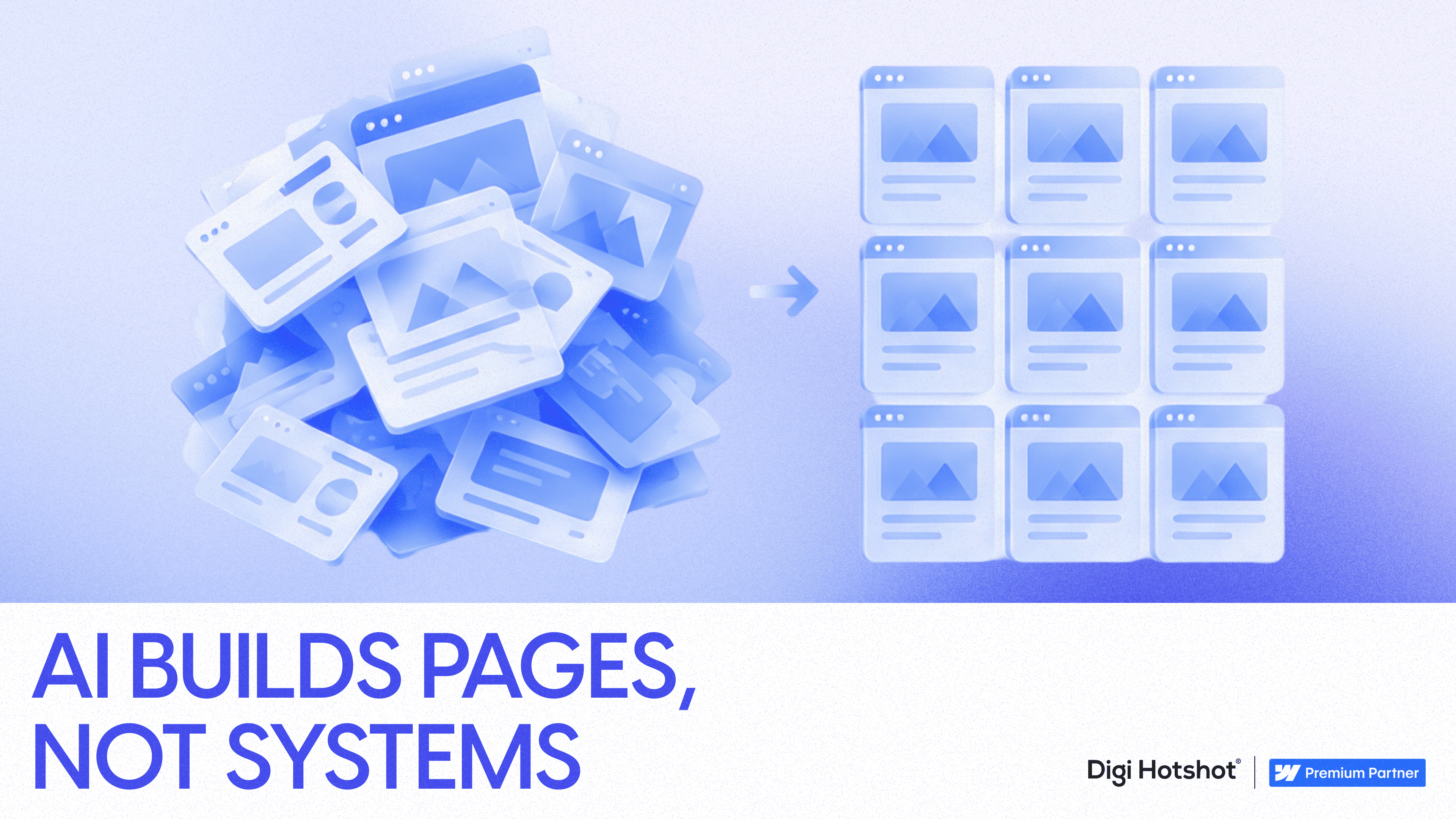


That's the real question underneath "should we just build this ourselves." Not whether Claude or an AI page builder can produce a page that looks fine. It can. The question is whether a two-to-six-person marketing team can run that page, and the fifty pages after it, without creating a new dependency on whoever wrote the original prompts.
In-house AI builds produce pages, not a system. What ships is a set of components with no shared architecture behind them, no governance layer for what can be published without review, and no accountability when something breaks three months after launch.
We see this constantly in our work with Series B marketing teams who come to us after a year of exactly this. Someone on the team, often the demand gen manager or a contractor, used an AI tool to spin up a handful of landing pages. Each one looks fine in isolation. None of them share a component system, so every new page is a fresh interpretation of the brand rather than a variation on a governed template. Nobody can tell you which version of the hero section is "the real one."
The bigger problem shows up the moment the site has to do real work. A page builder doesn't know how your form should map to HubSpot, how attribution should persist through a Chili Piper booking flow, or what happens to lead routing in Salesforce when someone changes a field name. Most AI-built sites have no integration layer at all, just embedded scripts bolted on wherever they'd fit. That works until marketing needs the CRM to actually trust what the website is sending it.
And when it breaks, there's no one to call. The contractor who built it has moved on. The AI tool doesn't own the consequences of a dropped lead or a broken form. The team is left debugging a system nobody designed, which is a worse position than the one they started in. This is the gap between having access to a tool and having operational ownership of a result. A marketing team can have both, but AI tools alone only ever give you the first one.
Enterprise scrutiny changes the website from a marketing page into a trust document, and that's exactly where ungoverned AI builds fall apart fastest. Security teams, procurement, legal, and compliance don't evaluate a site on how fast it loaded in the demo. They evaluate it on whether the claims are consistent, whether the forms behave predictably, and whether the company behind it looks like it has its operations in order.
Our work on the Atakama cybersecurity redesign is a direct example of what that requires. Atakama needed a site that could explain a genuinely complex security product to a technical buyer while holding up under the kind of scrutiny a CISO brings to a vendor evaluation. That meant more than a visual refresh. It meant a HubSpot-integrated rebuild where forms, routing, and lead data all connected cleanly, and where the marketing team could manage ongoing content without reopening the integration every time. The result was better lead quality for an enterprise security buyer, not because the pages looked prettier, but because the system behind them held together under the kind of review a security-conscious buyer actually runs.
That's the distinction that gets lost in "can we build this ourselves." An AI tool can write security-sounding copy. It can't tell you whether that copy survives a procurement team's fact-check, or whether your compliance language was actually reviewed by someone with the authority to approve it. When a CISO is in the room, the cost of getting the system wrong is a stalled deal, not a page that needs a quick edit. Fintech and healthtech teams feel this earliest, which is one reason our fintech-focused Webflow work and healthcare builds are built around review gates from day one, not added after the first compliance complaint.
The number that actually matters isn't what the build costs today. It's whether your marketing team can still move fast on this site in year three, without a developer, without an agency on retainer, without rebuilding the thing from scratch.
Year one is where in-house AI builds look like they're winning. Production feels cheap and fast. But the real year-one workload was never page generation, it was deciding what the site needs to say, establishing an information architecture, connecting analytics and forms correctly, and training the team on how to publish safely. AI can shorten the writing step. It doesn't touch the coordination and quality-control work that determines whether the site holds up.
Year two is where the gap becomes visible. A team running on a governed component system can ship a new solution page, a customer story, or a regional variant by reusing what's already built. A team running on ungoverned AI output is often doing the opposite: every new page adds inconsistency, and small changes start requiring someone to untangle what the last person did.
Year three is where ownership either pays off or collapses. TenOneTen Ventures, an LA-based seed fund with four unicorns in its portfolio and over a billion dollars in realized exits, migrated from WordPress to Webflow with us in November 2022. Since that migration, they've run the site independently for more than three years with zero agency dependency. No retainer, no standing developer relationship, just a marketing team operating a system that was built to be operated. That's the actual cost comparison: not what the build cost in month one, but whether the team is still fast, or still stuck, in month thirty-six. You can read the full build in our TenOneTen Ventures case study.
Speed is the right priority when a hard external deadline, not an internal preference, is forcing the timeline, and even then it needs a governed build underneath it. The clearest example in our own work is Ironflow AI, a defense-tech startup that needed to exit stealth on a fixed date with a site that could hold up to the scrutiny of investors, partners, and technically sophisticated buyers simultaneously.
We ran that as a two-phase build specifically because the deadline was non-negotiable. Phase one got a credible, enterprise-ready site live in time for the exit. Phase two filled in the depth the stealth deadline hadn't allowed for. That sequencing is the honest answer to "when does speed matter more than everything else": when the deadline is externally imposed and immovable, and the cost of missing it is reputational, not just operational. It's a different situation from a marketing team wanting a faster subscription-tool workaround because the usual build timeline feels slow. One is a real constraint. The other is usually a governance problem wearing a speed costume.
The honest version of this decision depends on what's actually at stake, not on whether your team is capable of using an AI tool. Both of these can be true for the same company at different points in its life.
Build in-house with AI tools if:
Hire a Webflow agency if:
AI tools increase what a marketing team can attempt. They don't increase what a marketing team can own, and ownership is what determines whether your site is still an asset in three years or a liability someone finally has to rebuild. Once you see the comparison as velocity and enterprise readiness over time, rather than build price or build speed, the in-house-versus-agency question stops being about capability and starts being about what's actually at stake for your pipeline.
If your site is already carrying enterprise deals, compliance review, or a CRM your team can't afford to break, book a discovery call and we'll walk through what a governed, marketing-owned build looks like for your specific stack.
Yes, if the agency builds a component-based system designed for non-technical use, not just a visually polished page. Our TenOneTen Ventures build is the proof: the team has run it independently for over three years since the 2022 migration with zero agency dependency, publishing and updating content without developer tickets.
Usually a full rebuild, because ungoverned AI output has no shared architecture to extend. Each page was built as a one-off, so adding a new product line, region, or campaign type means starting over rather than reusing a system. A properly architected Webflow build avoids this by treating every new page as a variation on existing components.
No. AI is useful for drafting copy, generating layout variations, and speeding up low-stakes page production. It doesn't replace the architecture, integration work, compliance review, or accountability a revenue-bearing site needs, which is the actual work an agency does.
Our migrations from WordPress, Joomla, Squarespace, or legacy HTML typically run 2-3 days for ongoing update cycles once the initial migration is complete, with the full rebuild scoped around preserving SEO rankings and content. Full detail is on our migration services page.
The main disadvantage is that the team absorbs a second full-time responsibility, site architecture and integration maintenance, on top of their actual job of generating pipeline. Without a governed system, every campaign launch risks becoming a debugging exercise instead of a marketing task.
No, a well-built system does the opposite. The agency's job is to build the architecture and governance rules so marketing can publish safely without needing a developer, which is the autonomy most teams were trying to get from AI tools in the first place.
Last Updated:
October 12, 2026
Book a 30-minute discovery call. We'll discuss your current challenges and show you exactly how we can help.
Your competitors aren't stuck in developer queues. They're launching campaigns, testing messages, and capturing market share while you're waiting for simple updates.
Eliminate the bottlenecks. Give your marketing team the infrastructure they deserve—fast, autonomous, built to scale.