

Est. 2019
Est. 2019
Last Updated:
June 20, 2026

Parth Gaurav
Founder & CEO
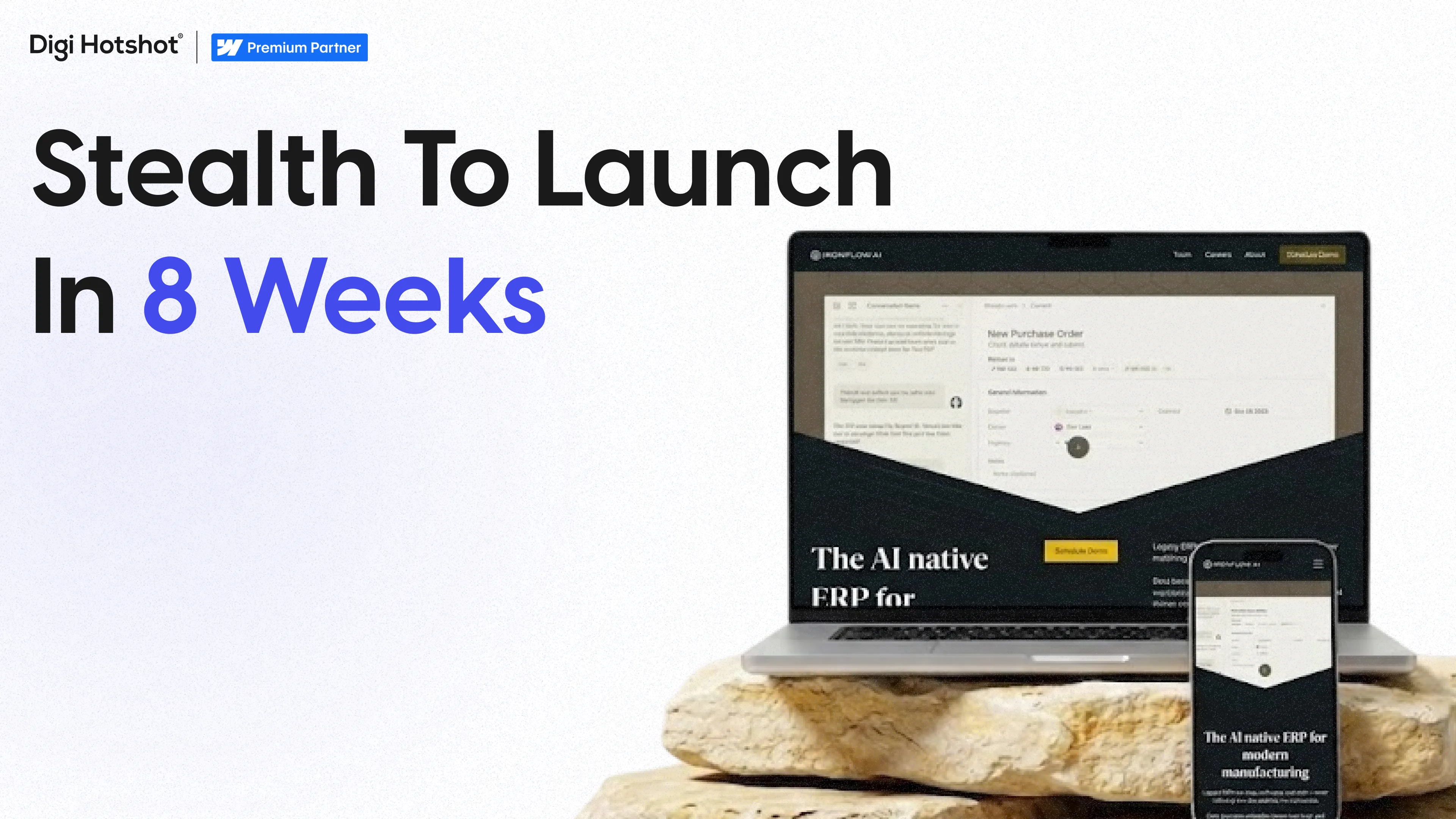


Quick answer: IronFlow AI, a Vista, CA-based defense-tech startup backed by Context Ventures and Shield Capital, had an immovable October 25 stealth-exit deadline. Digi Hotshot delivered the full website design and Webflow build in 8 weeks, split across two phases: a 7-section homepage at launch, then a custom About page and four Rive animations post-launch. Marketing took over with no developer dependencies.
By Parth Gaurav, Founder & CEO, Digi Hotshot. Last updated: June 15, 2026.
IronFlow AI is building the world's first AI-native ERP for advanced manufacturing. The team isn't a typical first-time founder story — the operators came out of Shield AI, Northrop Grumman's F-35 program, Apple, and MIT, with Context Ventures and Shield Capital backing the round. The product is real. The launch was the constraint.
The stealth-exit window opened on a fixed date — October 25 — and didn't bend. Until that date, the only public presence was a placeholder page. After that date, the audience the company actually cared about — DoD program offices, prime contractor procurement teams, military-veteran technical talent, and the next investors in the round — would form an opinion of the company in under thirty seconds on whatever site happened to be live.
In most categories, that's still a forgiving environment. A scrappy launch site signals scrappy startup. In defense procurement, it doesn't. A prime's supply-chain risk team isn't reading the homepage looking for charm. They're checking whether this is a company they can put on an Approved Vendor List, point at an OTA contract, or recommend to a program office without political risk. A "we're in stealth, give us a chance" placeholder reads as a disqualifier — not because it's true, but because the audience defaults to no.
So the brief wasn't "make the site look good by October 25." It was: between now and October 25, give us a site that does enterprise-grade credibility work from the first scroll, for an audience that's been trained by twenty years of prime-contractor websites to distrust everything that looks rushed.
The two-phase split was the calculated bet. Rather than push a full comprehensive site into the deadline and rush the parts that mattered most, DH proposed launching a polished foundation on Day One and adding depth afterward.
Phase 1 was the launch-day site. Seven sections. Dark mode design. A geometric grid pattern inspired by blueprint aesthetics — visually distinct from the generic AI startup look without crossing into novelty. The structure was deliberate:
Underneath the visible site, Phase 1 also shipped the analytics stack a serious B2B operation needs from Day One: GA4, Apollo.io visitor tracking, Contentsquare heatmaps, dual form submission paths so a "Schedule Demo" from a DoD email didn't get processed the same way as a generic "Contact Us," and a Klaviyo-style newsletter capture with customer-vs-investor segmentation.
That stack mattered for one reason: post-launch, the marketing team needed to see who was showing up before sales did. In defense procurement, the first hand-raise from an Approved Vendor reviewer or a prime's BD team is the lead. Missing it because analytics weren't wired in on Day One isn't a slow-burn cost. It's a deal.
Phase 1 went live on November 2, 2025 — inside the stealth-exit window.
The second phase added the work that didn't need to ship by October 25 — but absolutely needed to ship before the next round of conversations.
The About page came first. Team profiles with the actual pedigrees (Shield AI, Northrop, F-35, Apple, MIT) rendered the way a defense audience reads them — credentials visible, no over-design, no founder-influencer photography. Mission, culture, and careers sections were built into the same page architecture so the recruitment story and the credibility story sat together.
Four custom Rive animations were built to demonstrate product capabilities — the kind of moving explainers that do real work in a category where a static screenshot doesn't communicate what the software does. Rive over Lottie or video for one specific reason: the animations had to feel native to a product UI, respond to scroll, and stay sharp at any viewport without ballooning page weight.
Enhanced scroll-triggered interactions ran throughout the site after Phase 2 landed. The point wasn't decorative motion. It was that on a defense-buyer's second visit — the one that happens after the procurement conversation moves to "is this a real company" — the site needed to feel like a product, not a brochure.
Phase 2 was complete on December 2, 2025. The full handoff included team training on Webflow, so IronFlow's marketing function could publish, edit, and iterate without a developer in the loop.
The IronFlow build is specifically a defense-tech story, but the shape isn't unique to defense. Any company with a launch deadline tied to an external event — a stealth exit, a fundraise close, an industry conference, an RFP submission window — and a buyer audience that judges in thirty seconds runs into the same trap.
The trap is the "single perfect launch site" project. It takes four to six months. Two of those months fall on the wrong side of the deadline. The team launches with a half-finished version of what they actually wanted, or pushes the deadline and pays for it in lost momentum.
The two-phase pattern works because it separates two questions that usually get conflated:
Phase 1 answers the first question. Phase 2 answers the second. Defense-tech, fintech, healthtech, deep-tech hardware — any category where the buyer audience defaults to skepticism — the structure holds.
One outcome of building this way is that by the time Phase 2 closed, IronFlow's marketing team owned the site. Component-based architecture on Webflow, structured CMS for the content that would grow over time, and a 30-minute training session were enough. Adding a press hit, swapping the hero CTA, publishing a careers update, updating the team grid as the company hired — all of it happened without a developer ticket.
That's the same pattern DH has shipped for Column Tax over four years, and it's the reason marketing teams stop talking about engineering as a bottleneck after the site is live.
Defense-tech buyers — DoD program offices, prime contractor procurement teams, supply-chain risk reviewers — are trained by twenty years of vendor-vetting to read a website as a credibility filter, not a marketing surface. A placeholder or rushed launch site reads as procurement risk, not startup charm.
Yes, with two conditions: the launch-day scope is constrained to what the audience actually needs on Day One, and the team is willing to iterate fast in the first phase rather than perfect-everything-in-parallel. IronFlow's Phase 1 was a 7-section homepage with full analytics, demo capture, and a video hero. Phase 2 added the About page, custom Rive animations, and enhanced scroll interactions. Total elapsed time was eight weeks, with the stealth-exit launch landing inside the original deadline window.
Rive animations stay sharp at any viewport, respond to scroll and hover, and feel native to a product UI in a way pre-rendered video doesn't. For defense-tech and deep-tech founders where the product is the proof, Rive lets the marketing site demonstrate behavior rather than describe it. Page weight stays controlled, and the marketing team can swap states without a re-render pipeline.
It means the marketing team can publish, edit, and iterate on the site without a developer ticket. New team members, press hits, a CTA change, a new careers role — all of it happens inside Webflow. The build has to be set up for it (component-based architecture, structured CMS, training during handoff), but once it is, the engineering team gets to focus on the product instead of the marketing site.
If you're in the same window IronFlow was — a fixed launch date, an audience that judges in thirty seconds, a marketing site that has to do credibility work from Day One — the two-phase pattern usually fits.
What I can do is take a look at what you have today, your timeline, and your audience, and tell you whether the same Phase 1 / Phase 2 split makes sense for your situation. DH has shipped 50+ Webflow builds since 2019, including defense-tech, fintech, healthtech, and Series A–B SaaS launches on compressed timelines.
Last Updated:
June 20, 2026
Book a 30-minute discovery call. We'll discuss your current challenges and show you exactly how we can help.
Your competitors aren't stuck in developer queues. They're launching campaigns, testing messages, and capturing market share while you're waiting for simple updates.
Eliminate the bottlenecks. Give your marketing team the infrastructure they deserve—fast, autonomous, built to scale.